Anyone who has rented or owned a chalet in the French Alps knows the transport problem by heart. Resort shuttle buses stop running at almost precisely 5pm, just as après-ski is picking up. Private taxis, where they exist at all, charge €80-120 for a 15-minute transfer and must be booked hours in advance. And somebody in every chalet draws the short straw of staying sober to navigate icy mountain roads after dinner. It is an awkward, unscalable, and — as of 2026 — finally solvable problem. Full Self-Driving technology paired with electric vehicles is about to reshape the economics of alpine transport in a way that will permanently shift which ski properties are genuinely usable, and therefore which ones hold their value.
The global autonomous vehicle market is currently valued at around $220 billion and is on track to approach $650 billion by 2031, according to Mordor Intelligence. France is moving at the front of the European field — Renault has opened its Flins factory specifically for autonomous R&D, the PACA region has committed public money to autonomous mobility pilots, and Tesla's European rollout of FSD (Supervised) is now entering phase-two testing in 2026. None of this will be perfect in year one. But for alpine property, the trajectory is the point: a resort that is difficult to get around at 11pm today will be effortless to navigate by 2028-2030, and the properties that benefit from that shift will be priced accordingly.
This article is for buyers and current owners trying to work out what the autonomous-EV transition actually means for French ski property. We walk through the specific pain points the technology solves, the resorts and neighbourhoods that gain the most, the second-order effects on rental yields, and — crucially — which property types become less attractive as the transport calculus shifts. If you are weighing a purchase, the autonomous transition is one of the genuinely important structural trends you should factor in alongside snow reliability, altitude and brand strength.
The Problem Today
The 5pm Shuttle Problem Is Not Just Annoying — It's Structural
The après-ski transport gap exists for a simple reason: resort shuttle operations are expensive, drivers are unionised, and the fixed cost of running a full bus schedule to every peripheral hamlet in the evening has never justified the passenger volume. So the shuttles stop at 5pm, private taxis fill a tiny fraction of the demand at uneconomic prices, and in practice most renters either walk everywhere (fine if they are centrally located, painful if not) or nominate a sober driver (the universal taint on a ski trip).
For a property owner, this structural gap has a direct, if often unspoken, effect on rental value. Central-village properties walkable to lifts, restaurants and bars command a substantial premium precisely because guests do not need evening transport. Properties 800m from the village centre — in many resorts perfectly pleasant addresses — rent at meaningfully lower rates. Properties 2-3km out on the outskirts of resorts like Morzine, Méribel or Les Gets frequently rent at 20-30% discounts to equivalent central addresses, and a significant portion of that gap is attributable purely to evening access.
This is important because when an underlying friction is removed, the price premium associated with it tends to compress. Central properties will not fall in value as autonomous transport improves — scarcity and walkability matter for reasons beyond just the evening taxi problem. But properties on the periphery, which today trade at a discount, are likely to see that discount narrow meaningfully over the next decade. For buyers prepared to think five to ten years ahead, this is one of the clearer arbitrage opportunities in the French ski-property market.
The complementary effect is that rental yields for well-positioned peripheral properties — chalets with real views, modern spec and decent parking — should improve as their effective usability improves. A chalet 2km out of Morzine that rents today primarily to families with a hire car will, by 2028-2030, rent to a much broader cohort of guests who no longer need a car at all. That is a genuinely new market expansion.
75%
Estimated reduction in per-km operating cost for autonomous EV taxis versus conventional manual taxi operations
€220B → €650B
Global autonomous vehicle market projection from 2026 to 2031 (Mordor Intelligence)
2027-2030
Plausible deployment window for commercial autonomous shuttles in top-tier French alpine resorts
+0.5pt
Plausible uplift in net rental yield on peripheral properties from resolved evening transport friction
Technology Readiness
Tesla FSD, Renault Autonomous and the European Regulatory Calendar
The state of autonomous vehicle technology at the start of 2026 is meaningfully different from where it was even twelve months ago. Tesla's FSD (Supervised) has completed several waves of European type-approval testing and is on course for a France-wide rollout during 2026-2027. Waymo continues to expand its geo-fenced robo-taxi operations in the US and has opened preliminary talks with French municipalities about European pilots. Meanwhile Renault has invested heavily in autonomous development at its Flins facility — much of it aimed specifically at low-speed urban and peri-urban use cases that map directly onto resort town environments.
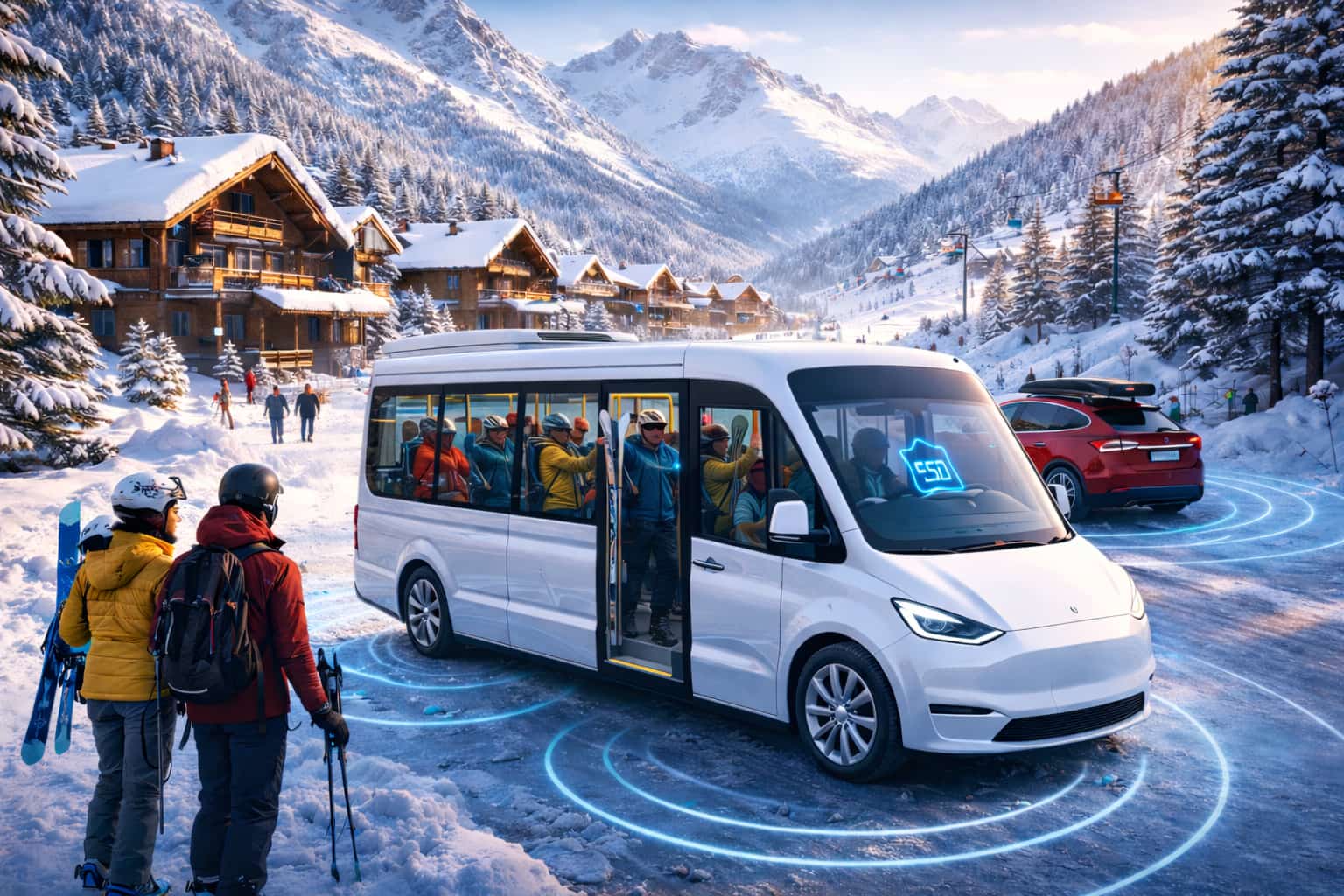
Critically for ski resorts, autonomous technology does not need to be perfect at 130 km/h on a motorway to be genuinely useful on a 30 km/h resort service road. The hardest unsolved problem in AV development is unpredictable urban traffic and pedestrian behaviour at speed. The easiest and most commercially viable deployments are low-speed, repeatable routes in controlled environments — exactly the profile of shuttle operations between a chalet and a village centre, or between a village centre and an airport transfer terminus. Expect the first French alpine autonomous-shuttle deployments to be these short, slow, geo-fenced routes rather than full FSD-level personal driving.
The French regulatory calendar is unusually favourable. The Mobilité d'Avenir framework passed in 2024 created a specific legal pathway for autonomous shuttle operation, and the PACA region has publicly committed to pilot deployments ahead of the 2030 Winter Olympics. Several Three Valleys operators have mentioned autonomous transport in their 2026-2030 strategic plans. The point is not that fully driverless cars will be ubiquitous in 2027 — they won't — but that the regulatory, commercial and technological elements are converging on a genuine 2027-2030 rollout window.
The property-value implication is that anyone buying in 2026 should think of autonomous transport as a near-certain medium-term tailwind rather than a speculative bet. Five years is a plausible horizon for meaningful deployment in the top-tier French resorts, and ten years is a near-certainty.
Resort Benefit Ranking: Biggest Autonomous-Transport Upside
Portes du Soleil (Morzine, Les Gets, Châtel)
La Plagne / Les Arcs satellites
3 Vallées peripheral addresses
Serre Chevalier / Alpes du Sud
Compact villages (Megève, Tignes)
Tier-3 low-altitude resorts
Resort Impact
Which Resorts Gain Most: Large Footprints, Dispersed Addresses, Modest Walkability
Not all French ski resorts benefit equally from autonomous transport. The resorts that gain the most are those with large, dispersed footprints where addresses 1-3km from the village centre are pleasant but poorly served by existing transit. The classic examples are the Portes du Soleil villages — Morzine, Les Gets, Châtel, Abondance — where beautiful chalets sit in peripheral hamlets that are well outside evening shuttle reach. La Plagne and Les Arcs similarly have many satellite neighbourhoods that will benefit enormously from on-demand transport between the sub-villages.
The Three Valleys top-tier brand resorts — Courchevel, Méribel, Val Thorens — have a slightly different dynamic. These resorts already command central-address premiums that reflect genuine scarcity, and they have extensive (if still 5pm-capped) shuttle operations during daytime. Autonomous transport will make peripheral Courchevel 1650, 1550 and Le Praz addresses meaningfully more competitive with Courchevel 1850 centre than they are today. That is a real value shift, but it is narrower than the shift for the Portes du Soleil resorts.
At the other end of the scale, the genuinely compact villages — Alpe d'Huez central, classic Megève village, Tignes Le Lac — see less direct benefit because their existing walkability is already excellent. These resorts are relatively priced as if walkability is essentially free, and the arrival of autonomous transport does not erode that premium much. They remain strong investments for other reasons, but the marginal technology tailwind is smaller.
The least obvious winners are resorts with strong airport-transfer appeal. Anywhere within 90-120 minutes of a major airport — Les Gets (Geneva), Samoëns (Geneva), Serre Chevalier (Turin/Marseille) — gains enormously from autonomous airport transfer, which is one of the earliest commercially viable use cases and is likely to roll out well before full resort-internal autonomous shuttles.
“When evening transport costs fall by three-quarters, every peripheral chalet that today rents at a discount because of access friction gets structurally re-rated.”
Cost Economics
The Price Maths: Why Autonomous EVs Undercut Taxis by 75%
The most compelling aspect of autonomous EV transport is the cost structure. Traditional resort taxi operations are dominated by labour (driver cost, often including mandated hours and union rules) and fuel. Remove the driver and replace diesel or petrol with electricity bought at off-peak rates, and the per-kilometre operating cost falls by 75-80%. This is not speculative — Waymo and other early operators have published operating cost data that supports this range. A €90 chalet-to-restaurant taxi round trip in Méribel today plausibly becomes a €20-25 autonomous ride by 2029-2030.
This price shift will not happen evenly. Early deployments will be offered at semi-subsidised introductory pricing to build demand, then corrected upward as operators need to fund capital depreciation. But the equilibrium price point for autonomous resort transport is structurally 60-75% below current manual-taxi pricing, and that is the number that buyers should model when thinking about how the economics of a peripheral property will evolve.
Electricity pricing is the other key variable. France's nuclear grid means off-peak EV charging is genuinely cheap — often €0.08-0.12 per kWh for commercial fleet operators on time-of-use tariffs. That makes French alpine resorts arguably the most favourable environment in Europe for autonomous EV fleet economics, since the combination of short routes, repeatable patterns and cheap overnight charging is close to ideal. The main constraint will be cold-weather range degradation, which remains a real factor for EVs at -10°C to -20°C but is manageable with thermal management systems that the latest generation of vehicles handles well.
The summary for property buyers is straightforward: the cost of evening transport in ski resorts is about to fall by roughly three-quarters over the next 5-7 years, and the properties that gain the most from that are exactly the ones that today trade at a discount because evening transport is difficult or expensive.
| Transport Type | Today's Cost | 2029-30 Cost | Availability |
|---|---|---|---|
| Resort shuttle bus | Included | Included | Until 5pm only |
| Manual taxi (15 min) | €80-120 | €70-100 | Limited, booked ahead |
| Private chauffeur | €90-150/h | €80-130/h | Pre-booked only |
| Autonomous EV (early) | n/a | €25-40 | On-demand, 24/7 |
| Autonomous EV (mature) | n/a | €15-25 | On-demand, 24/7 |
| Airport transfer (Geneva) | €250-400 | €120-200 | Pre-booked |
Yield Implications
Rental Yields, Booking Platforms and the New Usability Premium
The rental yield implications of autonomous transport are subtler than the headline cost numbers suggest. A property that today rents 45-55% of nights at peak rates because it is peripherally located will not suddenly rent 80% of nights — the fundamental constraints of high-season supply-demand in ski resorts do not disappear. But it will rent 50-60% of nights, it will attract a broader cohort of car-free renters, and its reviews will mention evening access less often as a friction. Taken together, these are perfectly measurable improvements that feed through into platform algorithms and capital values.
On the flip side, we expect booking platform algorithms to gradually de-weight 'distance from lifts' in the way they currently calculate desirability. Airbnb, Booking.com and the major specialist ski platforms currently use distance-to-lift as one of the key ranking signals. As autonomous transport makes that metric less operationally relevant, platforms will shift toward guest-review signals and actual booking conversion — at which point properties with good fundamentals but modest distance-to-lift scores will see improved visibility.
For buyers who are rental-yield focused, the implication is that you should be more relaxed about 1-2km distances from lifts than the market currently is — provided the fundamentals (size, spec, views, parking, modern DPE) are genuinely strong. For buyers focused on personal use, the implication is that you can afford to prioritise the things you actually care about (view, quiet, light, garden) without being punished by poor evening access.
A realistic model for a two-bed chalet 1.5km out of central Morzine: today a net yield of around 2.8-3.2%, potentially 3.2-3.8% net by 2029-2030 as the autonomous transport tailwind kicks in. That is a half-point yield improvement on the same capital investment, which over a decade compounds meaningfully.
2024
Mobilité d'Avenir framework
France passes legal framework enabling commercial autonomous shuttle deployment with clear liability rules.
2025
Tesla FSD European testing
Tesla enters phase-two FSD (Supervised) testing across multiple European markets including France.
2026
PACA autonomous pilots
The PACA region commits public funding for autonomous shuttle pilots ahead of the 2030 Winter Olympics.
2027
First resort pilots begin
Early low-speed geo-fenced autonomous shuttle deployments in one or two top-tier French alpine resorts.
2028-29
Commercial rollout expands
Expanding commercial availability across the top 15-20 French resorts; airport transfer becomes semi-autonomous.
2030
Olympics-era operations
French Winter Olympics showcases large-scale alpine autonomous transport; commercial operations hit steady state.
Risks and Limits
What Could Go Wrong: Regulation, Weather, Operator Economics
No investment thesis is complete without honest treatment of the downside. Autonomous transport faces three distinct risk categories in the alpine context. First, regulatory: France's regulatory framework is favourable but not yet complete, and the PACA region's 2030 commitments could slip. Second, weather: alpine snow, ice, fog and whiteout conditions are genuinely hard for current-generation sensor stacks, and early deployments may be limited to fair-weather routes. Third, operator economics: the first wave of operators will burn capital, and some of the early French alpine pilots may fold before reaching scale.
Our view is that these risks modify the timeline but not the direction. A pilot that folds in 2027 does not change the underlying fact that electrified autonomous transport is radically cheaper than manual taxi operations once scaled. A regulatory slip from 2027 to 2029 does not undo the 2030 Olympics commitment. And weather-related route restrictions are a solvable engineering problem that will be resolved over successive hardware generations.
The risk that should worry property buyers is not that autonomous transport fails to arrive — it is that it arrives unevenly, benefiting some resorts before others, and being rolled out to tier-one brands first. A peripheral property in a top-tier resort will benefit several years before a similarly peripheral property in a tier-three resort. If you are buying primarily for this transport tailwind, you should bias toward the resorts most likely to get autonomous deployments first — Courchevel, Val d'Isère, Méribel, Chamonix, Megève and the larger Portes du Soleil villages.
Buyer Action Plan
How to Factor Autonomous Transport Into a 2026 Purchase Decision
Our practical advice for buyers weighing a French ski property in 2026 is to treat autonomous transport as a real medium-term tailwind that should slightly shift your priorities — but not as a reason to pay above market for a speculative play. Concretely, this means being prepared to look at addresses 1-2km from the village centre that would have been ruled out on the traditional walkability criterion, provided the other fundamentals are strong. It means re-weighting view, light, garden and space relative to pure walking distance. And it means biasing toward resorts in the top-tier autonomous-deployment zone.
Financing has not changed: French non-resident mortgages remain accessible at 70-80% LTV with the most competitive profiles reaching 85%, and 2025 fixed rates have settled in the 3.4-4.5% range. The VAT reclaim on new-build VEFA purchases through a classified managed rental programme continues to make the effective price of new-build ~15% cheaper than it appears. Combine these financial realities with the autonomous-transport thesis and the practical conclusion is clear: well-chosen peripheral new-build property in the top-tier resorts is arguably the best risk-adjusted play in the current market.
As always, the specific property matters more than the macro thesis. If you want to talk through individual options, the Domosno team has been selling French ski property since 2005 and is happy to walk you through the peripheral-address inventory in each resort, with a pragmatic view on which ones plausibly benefit most from the autonomous transition.
FAQs
Frequently Asked Questions
Isn't autonomous driving in snow still a major unsolved problem?
It is hard at motorway speeds and in extreme whiteout conditions, but for 30 km/h geo-fenced resort routes on mapped roads, the engineering is tractable today. The first commercial deployments will be exactly these low-speed repeatable routes, not general-purpose FSD on icy mountain passes. Expect hardware generations to close the remaining edge cases through 2027-2030.
Which French resorts are most likely to deploy this first?
Top-tier brand resorts with strong operator balance sheets — Courchevel, Val Thorens, Méribel, Chamonix — and resorts within the PACA Olympics programme such as Serre Chevalier and Montgenèvre. The Portes du Soleil operators have also publicly mentioned autonomous transport in their strategic plans. Expect pilots by 2027 and meaningful commercial service by 2029-30.
How does this change property yields in practice?
Central, walkable properties are largely unaffected — their premium comes from scarcity and lifestyle as much as from transport. Peripheral properties 1-3km from village centres gain meaningfully, typically adding 0.3-0.6 points of net rental yield over 5-10 years as evening usability improves. That is a compounding effect worth modelling in any long-term investment analysis.
Won't early autonomous pricing be a lot higher than €15-25?
Yes. Early pilots will run at introductory pricing above genuine operating cost to build the market, and some will price high to fund depreciation on first-generation fleets. Our €15-25 mature-state estimate assumes steady-state operator economics by 2029-2030 — it is a medium-term number, not a day-one price.
Should I prioritise resorts within 90 minutes of an airport?
Yes — airport transfer is the first commercially viable autonomous use case, and it will roll out years before full resort-internal autonomous shuttles. Resorts near Geneva (Morzine, Les Gets, Samoëns, Megève, Chamonix) will gain airport autonomy earliest, and that alone can push effective rental demand higher for any property with strong fundamentals.
What about the cold-weather battery range problem?
Real but manageable. Modern EVs at -10°C lose 25-35% of range but recover fully above freezing, and the latest thermal management systems meaningfully reduce the gap. For short 30-40km resort routes and airport transfers this is a non-issue; the constraint only bites for long point-to-point intercity routes, which is not the commercial focus.
Could regulatory delays push the rollout beyond 2030?
Possibly, though the Olympics deadline concentrates minds in a way that ordinary bureaucratic timelines do not. Even a 2-3 year delay from our base case does not change the underlying thesis — the cost advantage of electric autonomous operations over manual taxis is large enough to survive meaningful slippage. The direction is more certain than the timing.
Is autonomous transport a reason to buy now or to wait?
Arguably a reason to buy now, because the price impact on peripheral properties is mostly still ahead of us. Buying before the market fully prices in the transport improvement captures the benefit as an owner rather than paying it to the previous seller. The {{link:Domosno team}} can walk you through specific peripheral-address inventory in the resorts best positioned for early deployment.